

VA Disability Math Explained: Why 50% + 50% Does Not Equal 100%
VA Disability Math Explained: Why 50% + 50% Does Not Equal 100%
One of the most confusing parts of the VA disability system is combined ratings.
Many veterans naturally assume:
“If I have a 50% rating and another 50% rating, that should equal 100%.”
But VA does not combine ratings using standard arithmetic.
This is commonly referred to as “VA math.”
Understanding how combined ratings work can help veterans better understand their decisions and avoid common misconceptions.
How VA Combined Ratings Work
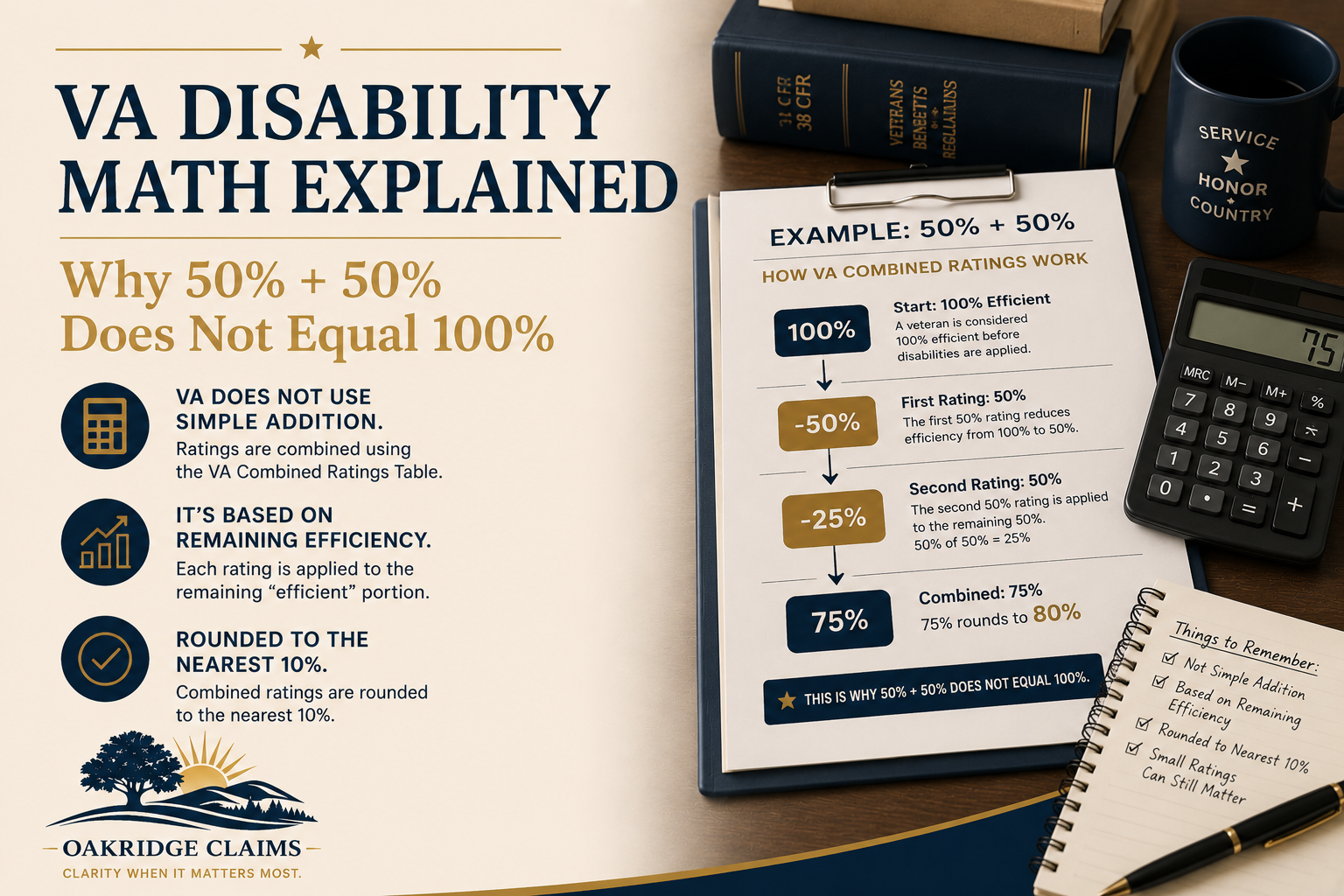
VA generally starts with the idea that a veteran is 100% efficient before disabilities are applied.
Each disability is then applied against the remaining “efficient” portion of the body—not the original 100% each time.
This is why ratings do not simply add together.
Example: 50% + 50%
Here is a simplified example:
- The first 50% disability reduces efficiency from 100% to 50%
- The second 50% disability is then applied to the remaining 50%
50% of the remaining 50% equals 25%.
So:
- 50% + 25% = 75%
VA then rounds combined ratings to the nearest 10%.
In this example, 75% rounds to 80%.
Why Veterans Get Confused
The percentages themselves look straightforward—but the underlying formula is not intuitive.
Many veterans are surprised when:
- multiple ratings still do not reach 100%,
- large ratings combine lower than expected, or
- a new rating changes the total less than anticipated.
This is extremely common.
What About Bilateral Factors?
VA math can become even more complicated when bilateral factors apply.
The bilateral factor generally involves paired extremities such as:
- both knees,
- both shoulders,
- both arms, or
- both lower extremities.
Additional calculations may apply before the final combined rating is determined.
Why Small Ratings Can Still Matter
Veterans sometimes dismiss smaller ratings like:
- 10%,
- 20%, or
- 30%.
But even smaller ratings may significantly affect:
- future combined ratings,
- bilateral calculations,
- Special Monthly Compensation (SMC) analysis, or
- eligibility for other benefits.
Every rating exists within the broader combined-rating framework.
Can You Predict Your Combined Rating?
Usually, yes—but it often requires understanding the VA combined ratings table and how ratings interact together.
Online calculators may help estimate outcomes, but the actual result still depends on:
- the underlying ratings,
- effective dates,
- bilateral factors, and
- how VA applies the calculations.
Common Misconceptions About VA Math
1. “My Ratings Should Simply Add Together”
This is probably the most common misunderstanding.
VA combined ratings are based on remaining efficiency—not simple addition.
2. “A New 10% Rating Barely Matters”
Sometimes even smaller ratings can affect future calculations more than veterans expect.
3. “I’m Close Enough to 100%”
The difference between combined ratings can be significant.
For example:
- 94% rounds down to 90%
- 95% rounds up to 100%
That distinction matters.
Final Thoughts
VA disability math is one of the most misunderstood parts of the claims system.
The combined rating formula often produces results that feel counterintuitive at first.
But understanding how VA calculates ratings can help veterans:
- better understand decisions,
- evaluate future claims strategically, and
- avoid common misconceptions about percentages.
Need Help Reviewing Your VA Ratings?
If you are unsure how your ratings combine—or whether additional claims may affect your overall evaluation—your case may benefit from a detailed review.
Oakridge Claims provides VA-accredited representation focused on evidence-based claim development and appeals.
Schedule a free consultation:
https://www.oakridgeclaims.com/prescreen
Clarity when it matters most.
This post is for informational purposes only and does not constitute legal or medical advice. Oakridge Claims is a private, independent organization and is not affiliated with the U.S. Department of Veterans Affairs. Representation is provided by a VA-accredited claims agent in accordance with 38 C.F.R. § 14.636. Outcomes depend on individual facts; no specific result is guaranteed.