

Supplemental Claim or Higher-Level Review? How to Choose After a Denial
Appeals & Decision Reviews
Supplemental Claim or Higher-Level Review? How to Choose After a VA Denial
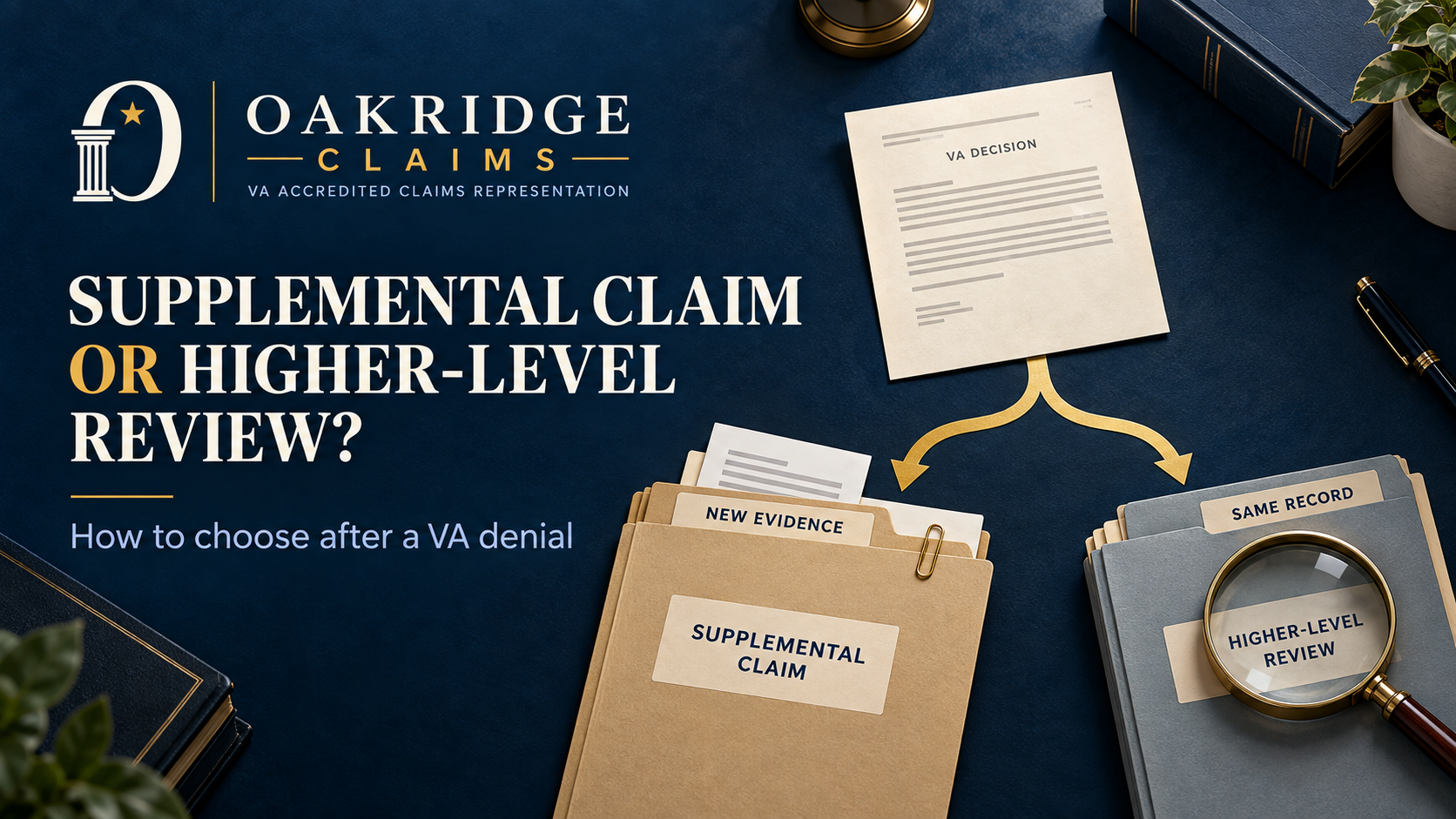
After receiving an unfavorable VA decision, choosing the correct review lane matters. A Supplemental Claim allows new and relevant evidence. A Higher-Level Review asks VA to examine the existing record for an error or difference of opinion. The better option depends on why VA denied the issue and whether the evidence needed to correct the decision is already in the claims file.
Supplemental Claim and Higher-Level Review Compared
| Question | Supplemental Claim | Higher-Level Review |
|---|---|---|
| Can you submit new evidence? | Yes. The evidence generally must be new and relevant. | No. The reviewer generally considers the existing evidentiary record. |
| What is the purpose? | To have VA readjudicate the issue using qualifying additional evidence. | To identify an error or difference of opinion based on the record VA already had. |
| Does the duty to assist apply? | It may apply after new and relevant evidence is presented or secured. | The reviewer may identify a pre-decisional duty-to-assist error and return the issue for correction. |
| Can you speak with the reviewer? | There is no HLR-style informal conference. | An optional informal conference may be requested. |
| Which form is used? | VA Form 20-0995 | VA Form 20-0996 |
| When should it generally be filed? | It may be filed at any time, but filing within one year can be important for preserving the potential effective date. | Generally within one year of notice of an initial claim or Supplemental Claim decision. |
When a Supplemental Claim May Be the Better Option
A Supplemental Claim is generally appropriate when the prior record was missing evidence needed to establish entitlement.
Under 38 C.F.R. § 3.2501 , evidence is new when it was not previously part of the record before VA adjudicators. Evidence is relevant when it tends to prove or disprove a matter at issue. Relevant evidence may also include evidence raising a theory of entitlement that VA did not previously address.
A Supplemental Claim may be the better lane when you have:
- A new medical opinion addressing service connection or secondary service connection
- Private treatment records VA did not previously obtain
- A new diagnosis when the prior claim was denied because no current disability was shown
- A buddy statement describing an in-service event, injury, or observable symptoms
- Personnel, deployment, unit, or exposure records not previously considered
- Evidence addressing aggravation by a service-connected disability
- Evidence supporting a new theory of entitlement
The most useful evidence is not necessarily the longest submission. It is the evidence that addresses the specific element VA found missing.
Example: The Record Was Missing a Nexus
VA concedes that the veteran has a current disability and experienced an injury during service, but denies the claim because the record does not connect the two.
If the veteran obtains a competent medical opinion addressing that relationship, a Supplemental Claim may be appropriate because the opinion is new and speaks directly to the reason for denial.
Example: VA Did Not Have the Relevant Private Records
VA denies the claim without considering private records that document the onset, chronicity, or severity of the condition. If those records were not previously part of the claims file, the veteran may submit them or identify them for VA to obtain through a Supplemental Claim.
VA explains the requirements and provides examples on its official Supplemental Claims page .
When a Higher-Level Review May Be the Better Option
A Higher-Level Review may be appropriate when the evidence needed to decide the issue favorably was already in the record, but VA overlooked it, misapplied the law, or made another factual or legal error.
Under 38 C.F.R. § 3.2601 , a higher-level adjudicator reviews the prior decision de novo, without giving deference to the earlier adjudication. However, the evidentiary record is generally limited to what VA had when it issued the decision under review.
A Higher-Level Review may be worth considering when:
- VA overlooked favorable medical evidence already in the claims file
- VA applied the wrong regulation or rating criteria
- The decision is inconsistent with VA’s own favorable findings
- VA assigned an incorrect effective date based on the existing procedural history
- VA failed to address a reasonably raised theory of entitlement
- VA relied on an inadequate examination obtained before the decision
- VA failed to obtain identified records before issuing its decision
- The existing evidence reasonably supported a higher evaluation
Example: VA Overlooked a Favorable Medical Opinion
A favorable medical opinion was already in the claims file before VA issued its decision, but the Reasons for Decision do not address it.
If no additional evidence is needed, a Higher-Level Review may allow the veteran or representative to identify the overlooked evidence and explain why the existing record supported a different result.
Example: VA Applied the Wrong Rating Criteria
The examination and treatment records already documented the symptoms required for a higher evaluation, but VA applied the wrong diagnostic criteria or failed to account for qualifying symptoms.
Because the dispute concerns the application of law to existing evidence, a Higher-Level Review may be more appropriate than resubmitting the same records through a Supplemental Claim.
VA provides additional information on its official Higher-Level Review page .
You Cannot Add New Evidence During a Higher-Level Review
This limitation is critical. A Higher-Level Review is not the correct lane when the claim requires evidence that was not in the record when VA issued the prior decision.
A veteran may identify evidence that VA overlooked, explain how the existing evidence should have been evaluated, and present legal argument. But the veteran cannot use the Higher-Level Review to add a new medical opinion, treatment record, buddy statement, or other substantive evidence.
Labeling a new factual statement as “argument” does not necessarily make it part of the permitted record. If the statement introduces facts VA did not previously have, a Supplemental Claim or an appropriate Board Appeal lane may be necessary.
What Is an HLR Informal Conference?
A veteran or accredited representative may request one optional informal conference with the higher-level reviewer. The conference provides an opportunity to identify specific factual or legal errors in the decision.
An effective informal conference may address:
- The specific finding being challenged
- Evidence in the existing record that VA overlooked
- An incorrect legal or regulatory standard
- An inadequate examination or medical opinion
- A pre-decisional duty-to-assist error
- An incorrect evaluation or effective date
An informal conference is not a hearing, and it cannot be used to submit new evidence. Requesting one may also increase the time needed to complete the review.
The value of an informal conference depends on preparation. Simply stating that the decision was unfair is less useful than identifying the exact error, the relevant evidence already in the record, and the law that should control the outcome.
What Happens When the Higher-Level Reviewer Finds a Duty-to-Assist Error?
The higher-level reviewer cannot simply add new evidence to the closed HLR record. However, the reviewer may determine that VA failed to satisfy its duty to assist before issuing the prior decision.
Examples may include failing to obtain adequately identified records or relying on an examination that was insufficient to decide the claim.
When VA identifies a qualifying pre-decisional duty-to-assist error, it should return the issue for correction. VA may then obtain the missing records, request a new medical opinion, or schedule another examination before issuing a new decision.
The general duty-to-assist requirements appear in 38 C.F.R. § 3.159 .
Which Lane Should You Choose?
Start with these questions:
- Why did VA deny the issue?
- What elements did VA favorably find?
- What element did VA find missing?
- Was the evidence needed to prove that element already in the record?
- Do you need to add or identify additional evidence?
- Did VA fail to satisfy its duty to assist before the decision?
- Is the disagreement primarily factual, evidentiary, or legal?
If the evidence needed to correct the decision was already in the claims file, a Higher-Level Review may be appropriate.
If the claim needs additional evidence to address the denial, a Supplemental Claim may be the better option.
When Neither Option May Be the Best Fit
Supplemental Claims and Higher-Level Reviews are not the only review options. A Board Appeal may be appropriate when the veteran wants review by a Veterans Law Judge, needs a particular evidentiary docket, or presents a complex factual or legal dispute.
A claim for increased disability compensation may be appropriate when a service-connected condition became worse after the period addressed in the prior decision. VA advises that worsening of an already service-connected disability is generally handled through an increased-rating claim rather than a Supplemental Claim.
The available options also depend on which type of decision VA most recently issued. For example, VA generally does not permit another Higher-Level Review following a Higher-Level Review decision or a Board decision on the same issue. After an HLR decision, the veteran may generally file a Supplemental Claim or request a Board Appeal.
Protecting the Potential Effective Date
For most VA benefits decisions, the veteran generally has one year from the date of the decision notice to select an eligible review option and preserve continuous pursuit.
Under 38 C.F.R. § 3.2500 , continuously pursuing an issue through eligible and timely review options may preserve the effective date connected to the earlier claim.
A Supplemental Claim may generally be filed after the one-year period, but a later filing can result in the loss of an earlier potential effective date unless another exception applies. A Higher-Level Review ordinarily must be requested within one year of an eligible decision.
Do not wait until the deadline is approaching to determine which lane fits the record.
Received a VA Denial? Choose the Review Lane Carefully.
The correct strategy begins with the decision letter and the evidence VA actually considered. Filing a Supplemental Claim when the record was already sufficient may create unnecessary work. Requesting a Higher-Level Review when the claim needs additional evidence may leave the central deficiency unresolved.
Oakridge Claims can review the decision, claims-file evidence, favorable findings, examination reports, and procedural history to determine which review option may best address the denial.
Consider requesting a review if:
- You are unsure why VA denied the claim
- You have new medical or lay evidence to submit
- VA overlooked favorable evidence already in the file
- You believe VA applied the wrong rating criteria or regulation
- The VA examination appears inadequate
- You are approaching the one-year decision-review deadline
Before selecting a review lane, identify the error, determine whether new evidence is required, and protect the applicable deadline.
Request a case review with Oakridge Claims
Website:
oakridgeclaims.com
Phone:
(760) 702-4507
Oakridge Claims provides VA-accredited claims representation focused on disability claims and appeals.
Related reading: Supplemental Claims, Higher-Level Reviews, and Earlier Effective Dates.