

How to Write a Winning VA Personal Statement (With Examples)
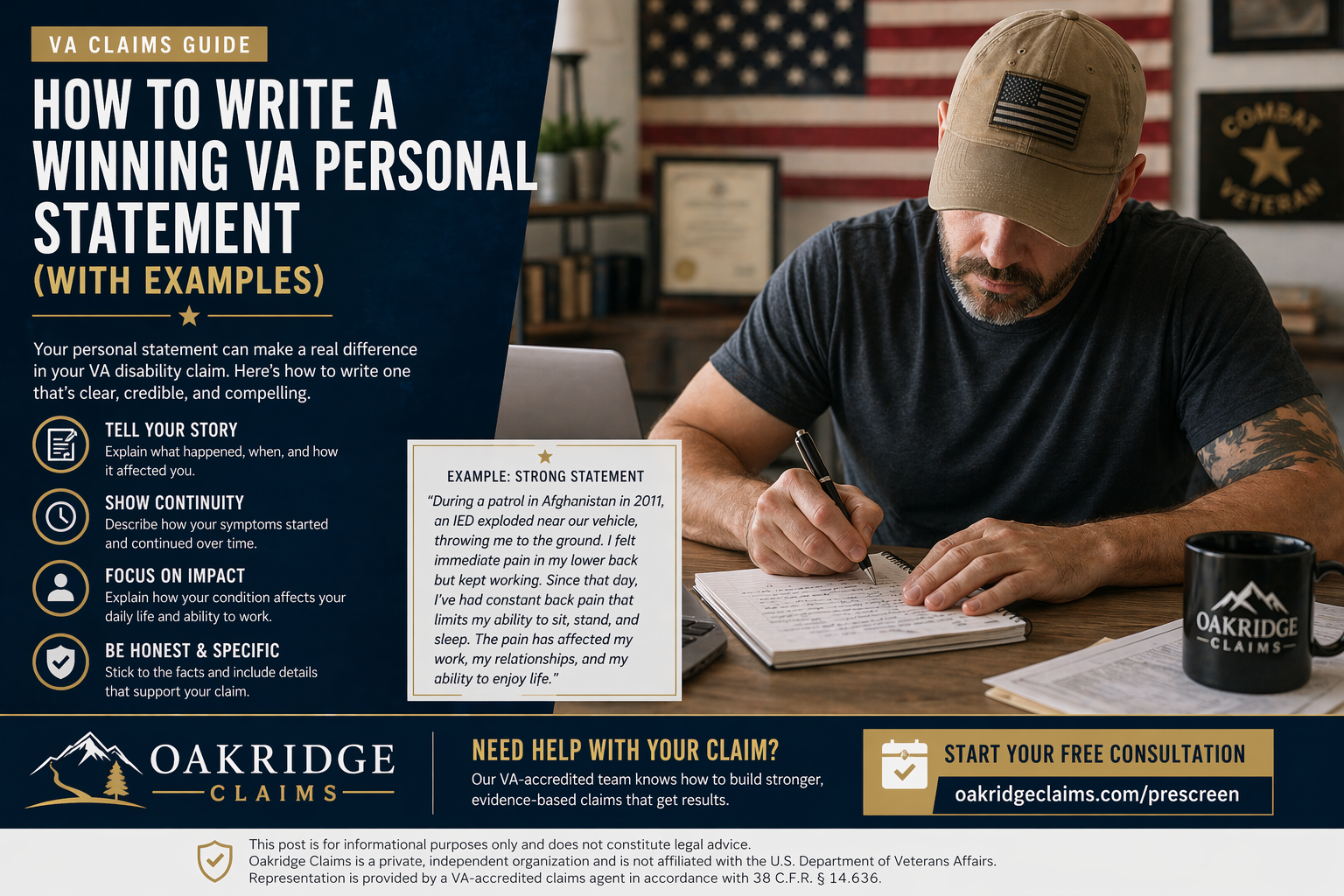
How to Write a Winning VA Personal Statement (With Examples)
A VA personal statement can be one of the most powerful pieces of evidence in your claim — when it’s done correctly.
It allows you to explain what happened, how your condition started, and how it affects you today — in your own words.
But most veterans either underwrite it… or unknowingly hurt their claim.
This guide shows you how to do it the right way.
What Is a VA Personal Statement?
A personal statement (often submitted on VA Form 21-4138) is your written account of:
- What happened during service
- When your condition started
- How it has continued over time
- How it affects your daily life today
Under VA regulations, lay evidence (your statement) can be considered competent and credible evidence — especially when it relates to observable symptoms.
What Makes a Strong Statement?
Strong statements are:
- Specific — Dates, locations, events
- Consistent — Aligns with your service and records
- Detailed — Describes symptoms, not just conclusions
- Honest — No exaggeration or guesswork
The goal is not to sound “medical.” It’s to be clear and credible.
The Structure That Works
A simple, effective format:
- In-Service Event — What happened
- Onset of Symptoms — When issues began
- Continuity — How it persisted over time
- Current Impact — How it affects you today
Example: Weak vs Strong Statement
Weak:
“My back hurts from the military and has gotten worse.”
Strong:
“During a field exercise in 2012, I injured my lower back while lifting equipment. I felt immediate pain but did not seek treatment at the time. Since then, I have experienced ongoing lower back pain, stiffness, and difficulty standing for long periods. Over the past several years, the pain has worsened and now affects my ability to work and perform daily activities.”
The difference is detail, clarity, and continuity.
Common Mistakes to Avoid
- Being too vague (“it hurts” without context)
- Leaving out how the condition affects daily life
- Contradicting medical records
- Overstating or exaggerating symptoms
When Personal Statements Matter Most
Personal statements are especially important when:
- You don’t have in-service medical records
- You’re filing for secondary conditions
- You’re relying on continuity of symptoms
- You are a combat veteran (lay evidence carries additional weight under federal law)
Final Thought
Your statement is your voice in the claims process.
When written clearly and correctly, it can significantly strengthen your case.
Need Help With Your Claim?
If you want your claim built strategically — not just submitted — professional guidance can make a difference.
Oakridge Claims provides VA-accredited representation focused on evidence development and proper application of VA law.
Start your free consultation here
Clarity when it matters most.
This post is for informational purposes only and does not constitute legal advice. Oakridge Claims is a private, independent organization and is not affiliated with the U.S. Department of Veterans Affairs. Representation is provided by a VA-accredited claims agent in accordance with 38 C.F.R. § 14.636.