

VA Board Appeals: What Veterans Should Know About BVA Appeals
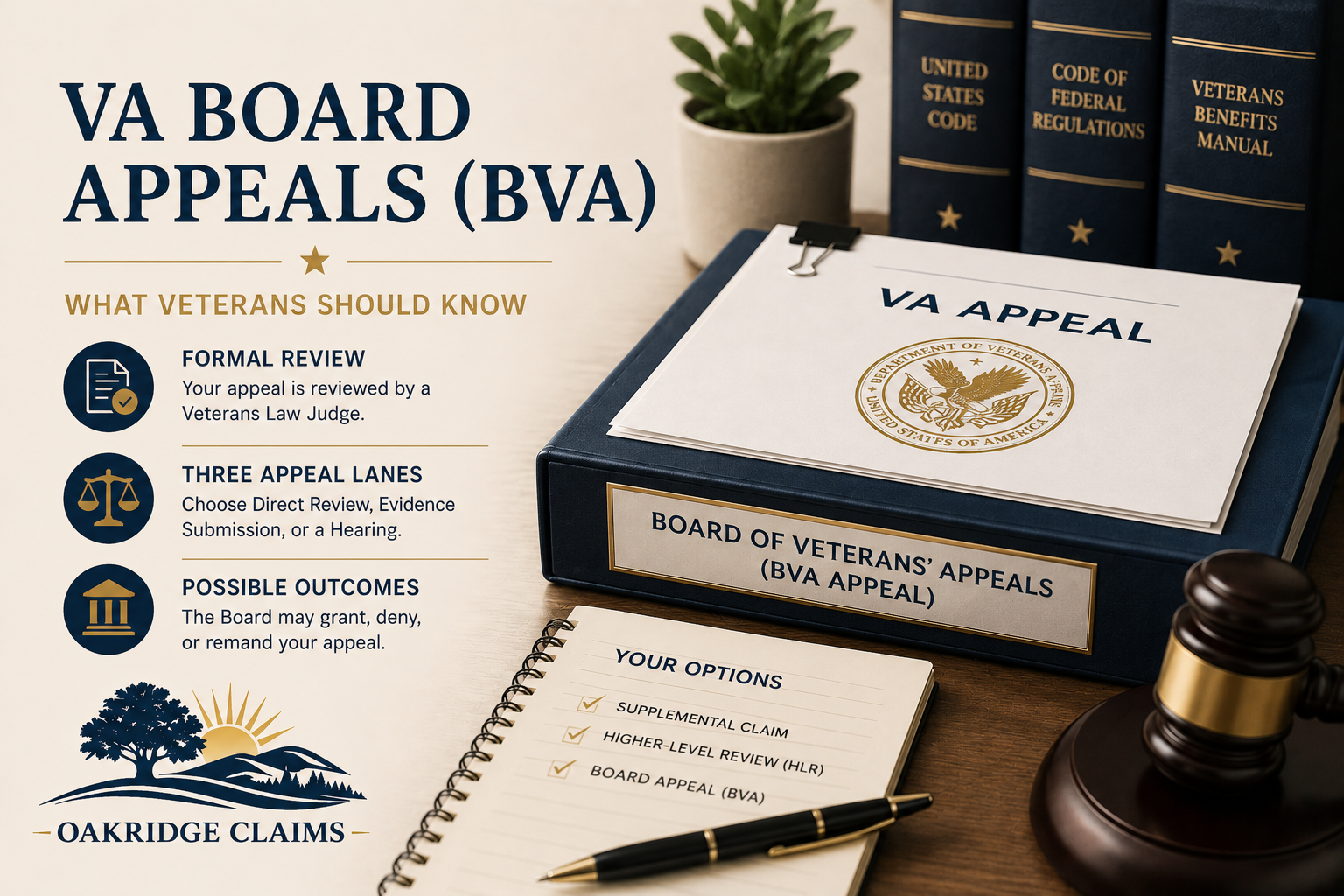
VA Board Appeals: What Veterans Should Know About BVA Appeals
After a VA denial, some veterans eventually consider appealing to the Board of Veterans’ Appeals (BVA).
Board Appeals are different from Supplemental Claims and Higher-Level Reviews.
They are generally more formal, more complex, and often involve significantly longer timelines.
Understanding how Board Appeals work—and when they may or may not make sense—is important before choosing this review lane.
What Is the Board of Veterans’ Appeals?
The Board of Veterans’ Appeals is part of the Department of Veterans Affairs and is responsible for reviewing appealed VA decisions.
Board Appeals are reviewed by Veterans Law Judges (VLJs).
The Board may:
- grant the appeal,
- deny the appeal, or
- remand the claim for additional development.
How Is a Board Appeal Different?
Unlike a Higher-Level Review, a Board Appeal places the case before a Veterans Law Judge rather than a regional office reviewer.
Board Appeals are often used when:
- complex legal or medical issues exist,
- multiple denials have occurred,
- VA repeatedly relied on inadequate examinations, or
- the veteran wants a judge to review the claim directly.
However, Board Appeals also typically involve longer wait times than other review options.
The Three Board Appeal Lanes
1. Direct Review Lane
In the Direct Review lane:
- no new evidence is submitted, and
- no hearing is requested.
The judge reviews the existing record as it stood at the time of the prior decision.
This lane is often chosen when the veteran believes VA already had enough evidence to grant the claim.
2. Evidence Submission Lane
This lane allows the veteran to submit additional evidence within a specified time period.
No hearing occurs.
This option may make sense when the claim needs additional development but a hearing is unnecessary.
3. Hearing Lane
The Hearing Lane allows the veteran to appear before a Veterans Law Judge.
Veterans may provide testimony and submit evidence.
However, this lane is often associated with the longest wait times.
What Is a Remand?
One of the most misunderstood Board outcomes is a remand.
A remand is not automatically a win or a loss.
It generally means the Board determined additional development is necessary before a final decision can be made.
Examples may include:
- new C&P examinations,
- missing records,
- inadequate medical opinions, or
- duty-to-assist errors.
Remands are common in Board Appeals.
When Might a Board Appeal Make Sense?
Board Appeals may be appropriate when:
- the case involves complicated medical or legal issues,
- multiple prior denials exist,
- VA repeatedly failed to properly address evidence,
- the veteran wants formal appellate review, or
- regional office review options were unsuccessful.
When Might a Board Appeal NOT Be the Best Option?
Not every denial requires a Board Appeal.
In some cases, a Supplemental Claim or Higher-Level Review may resolve the issue more efficiently.
For example:
- missing evidence may be better addressed through a Supplemental Claim,
- clear factual or legal errors may fit HLR better, or
- straightforward development issues may not require a judge’s review.
The correct review lane often depends on the actual reason for denial.
Common Board Appeal Mistakes
1. Choosing a Hearing When It Is Not Necessary
Hearings can significantly increase wait times.
In some situations, testimony may add little to the existing evidence.
2. Not Understanding the Record
Many veterans pursue Board Appeals without fully understanding:
- why VA denied the claim,
- what evidence is missing, or
- whether the issue is factual, medical, or legal.
3. Treating the Board Like a “Retry”
Board Appeals are not simply a chance to restart the process.
Strategic evidence development and issue identification still matter.
Final Thoughts
Board Appeals are one of the most powerful review options available in the VA system—but they are also one of the most complex.
Not every denial belongs at the Board.
The most important question is often:
What specifically caused the denial, and which review lane is best suited to address it?
Understanding that distinction can significantly affect the direction of an appeal.
Need Help Reviewing a VA Appeal?
If your VA claim was denied and you are unsure whether a Board Appeal, Higher-Level Review, or Supplemental Claim may make sense, your case may benefit from a detailed review.
Oakridge Claims provides VA-accredited representation focused on evidence-based claim development and appeals.
Schedule a free consultation:
https://www.oakridgeclaims.com/prescreen
Clarity when it matters most.
This post is for informational purposes only and does not constitute legal or medical advice. Oakridge Claims is a private, independent organization and is not affiliated with the U.S. Department of Veterans Affairs. Representation is provided by a VA-accredited claims agent in accordance with 38 C.F.R. § 14.636. Outcomes depend on individual facts; no specific result is guaranteed.