

CARC Paint (Chemical Agent Resistant Coating)
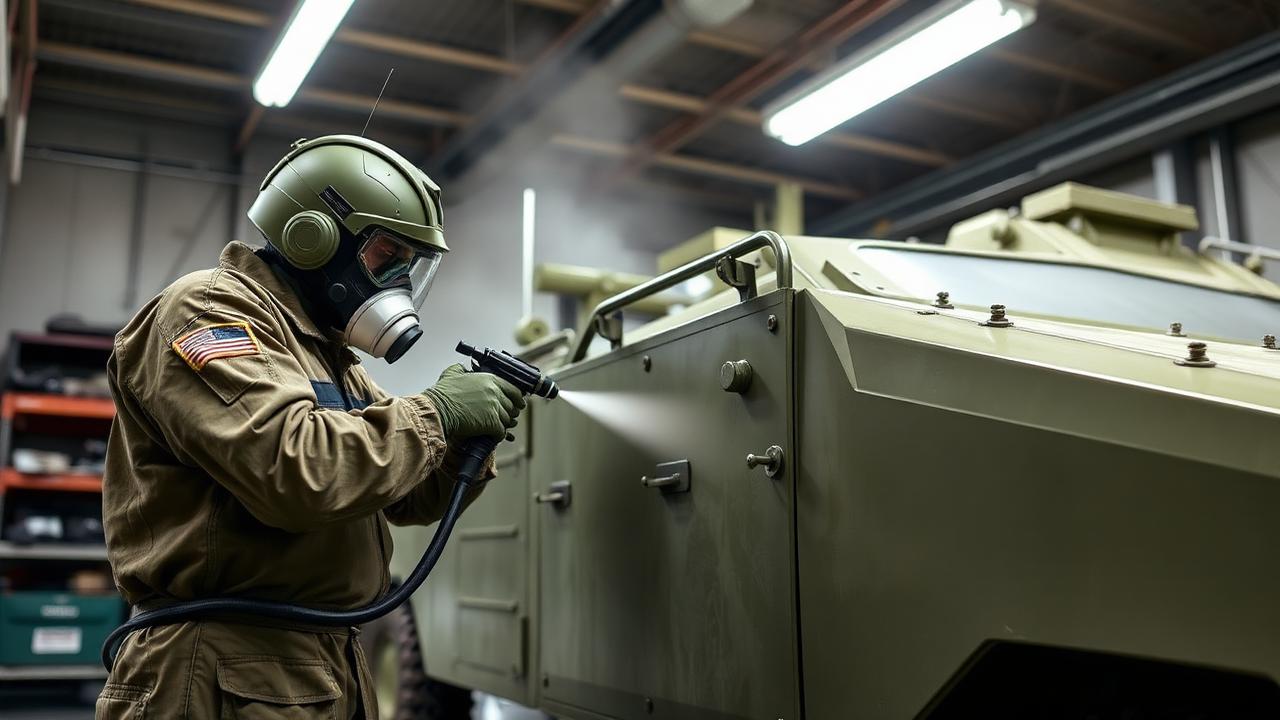
What CARC paint exposure is
- Hexamethylene diisocyanate (HDI) — the polyurethane hardener and the most hazardous component when aerosolized.
- Solvents — including xylene, MEK, and other VOCs in the CARC formulation.
- Hex chrome (prior formulations) — older CARC primers contained hexavalent chromium.
- Risk is highest during spraying and sanding; cured CARC is generally low risk.
Who was exposed
- Motor pool mechanics and body shop personnel who painted vehicles and equipment.
- Aircraft maintainers performing depot-level repainting.
- Engineer and construction units painting equipment in the field.
- Sandblasters and surface-prep crews removing old CARC layers.
Recognized conditions & VA framework
- Occupational asthma — including reactive airways dysfunction syndrome (RADS).
- Hypersensitivity pneumonitis.
- Chronic bronchitis and chronic obstructive pulmonary disease (COPD).
- Contact dermatitis and chemical sensitization.
- Sinusitis and chronic rhinitis.
Evidence to gather
- Service records showing or duty position involving paint operations (63B mechanic, body shop, aircraft maintainer, etc.).
- Buddy statements describing spray operations without respirators or in poorly ventilated spaces.
- Industrial hygiene reports if available from your installation.
- Pulmonary function tests, methacholine challenge, or specific IgE testing for isocyanates.
- opinion from a pulmonologist or occupational medicine physician.
Claim path
- File as — there is no CARC presumption.
- Cite occupational exposure to isocyanates and reference VA Public Health CARC guidance.
- If the claimed lung condition is also covered under § 1119 (chronic bronchitis, COPD, asthma diagnosed after qualifying service), file under PACT Act presumption instead — it is the cleaner path for post-9/11 veterans.
Where these claims break down
- ×Filing as a generic 'lung condition' without documenting the CARC exposure pathway.
- ×Not getting pulmonary function testing and methacholine challenge before the C&P exam.
- ×Assuming respirator use disproves exposure — many shops did not enforce respirator discipline.
Frequently Asked Questions
Useful Tools & Topics
Have questions about your specific case?
Tell us about your claim, rating increase, or VA decision for a free case evaluation — a decision letter is helpful but not required. If your matter fits our current scope, we'll invite you to schedule a consultation.
Disclaimer: This page is for educational purposes only and does not constitute legal advice. Oakridge Claims is a private business and is not affiliated with, endorsed by, or operated by the U.S. Department of Veterans Affairs. No guarantees of outcomes are made. Each claim is decided on its individual facts.
Related guides
Industrial solvents
All eras (especially aviation maintenance, motor pools, paint shops). Military maintenance operations rely on industrial solvents — trichloroethylene (TCE), tetrachloroethylene (PCE), benzene, toluene, xylene, …
Khamisiyah & chemical warfare agents
Khamisiyah: March 1991 · Edgewood/CHASE: 1955 – 1975. Three distinct warfare-agent exposure events have VA recognition. Khamisiyah (March 1991): U.S. forces demolished an Iraqi ammunition depot …
Fort McClellan, Alabama
1935 – 1999 (Chemical Corps School & WAC Center). Fort McClellan housed the U.S. Army Chemical Corps School, the Women's Army Corps Center, and Anniston Army Depot operations. Soldiers, trai…
Pyridostigmine bromide (PB pills)
1990 – 1991 (Operations Desert Shield and Desert Storm). Pyridostigmine bromide (PB) is an investigational nerve-agent pretreatment fielded during the 1990 – 1991 Gulf War. Roughly 250,000 U.S. ser…