

Kuwait Oil-Well Fires (1991)
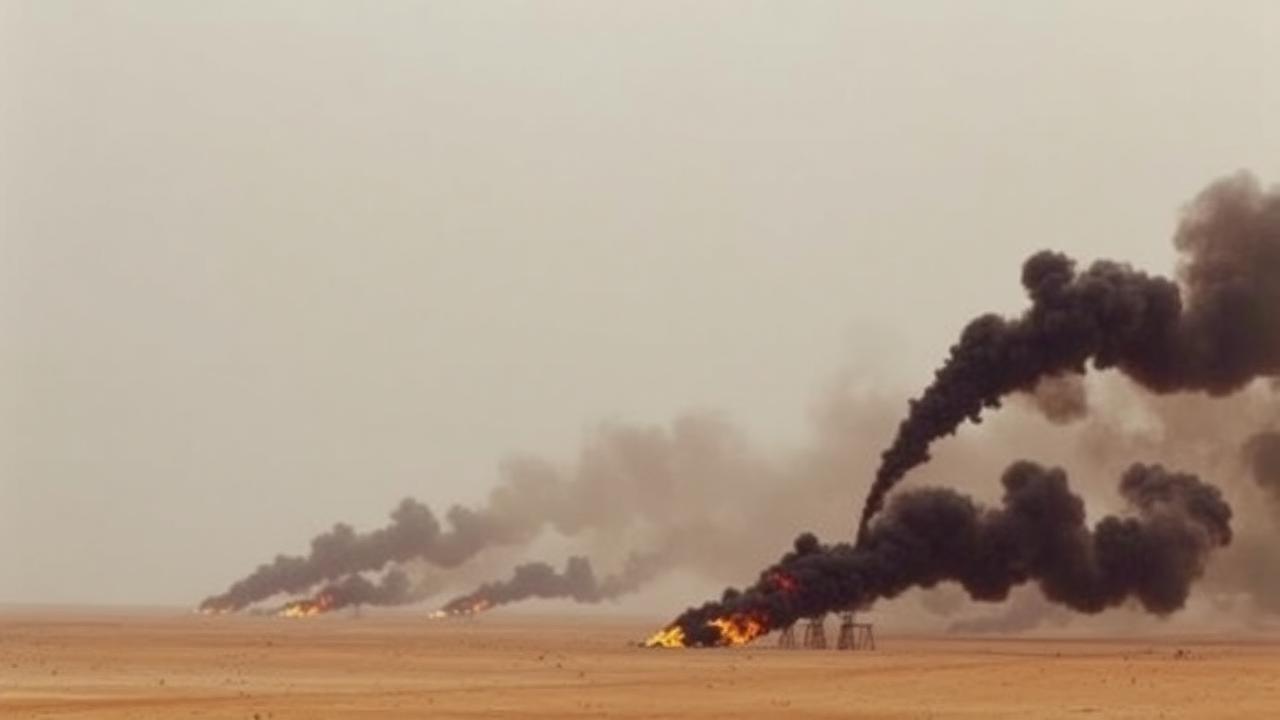
What Kuwait oil-well fires is
- Smoke from ~600 burning oil wells across Kuwait and northern Saudi Arabia.
- Fine particulate matter (PM2.5 and PM10) at levels far exceeding ambient air quality standards.
- PAHs, benzene, sulfur dioxide, nitrogen oxides, and heavy metals (vanadium, nickel).
- Soot deposition on the ground and in unit billeting areas.
Who was exposed
- Ground combat units operating in Kuwait, southern Iraq, and northern Saudi Arabia during and after the fires.
- Air crews flying through or near the plumes.
- Engineer and EOD units involved in fire suppression and well capping.
- Service members at downwind installations across the theater.
Recognized conditions & VA framework
- Oil-well fire exposure feeds into both 38 CFR § 3.317 () and the § 1119 presumption for post-9/11 service members later deployed to Southwest Asia.
- § 1119 presumptive cancers and respiratory conditions: asthma, chronic bronchitis, chronic rhinitis, COPD, sinusitis, constrictive bronchiolitis, emphysema, lung cancer (any type), brain cancer, glioblastoma, and others.
- Chronic multisymptom illness and undiagnosed illness under § 3.317.
Evidence to gather
- DD-214 showing Southwest Asia service in 1991 or later.
- Unit records placing the downwind of the fires (Kuwait, southern Iraq, eastern Saudi Arabia).
- Treating-provider documentation of respiratory disease, cancer, or chronic symptoms.
- Buddy statements describing the soot-blackened landscape, visible plumes, and breathing difficulty.
Claim path
- For listed conditions, file under 38 CFR § 3.320 (airborne hazards presumption) — no required.
- For chronic multisymptom illness, file under § 3.317.
- For other conditions, file with a opinion citing oil-well fire combustion products.
Where these claims break down
- ×Assuming oil-well fires are only a Gulf War issue — Desert Storm-era and post-9/11 veterans can both reach a presumption.
- ×Not specifying PACT Act § 1119 on the claim form when the diagnosed condition is listed.
Frequently Asked Questions
Useful Tools & Topics
Have questions about your specific case?
Tell us about your claim, rating increase, or VA decision for a free case evaluation — a decision letter is helpful but not required. If your matter fits our current scope, we'll invite you to schedule a consultation.
Disclaimer: This page is for educational purposes only and does not constitute legal advice. Oakridge Claims is a private business and is not affiliated with, endorsed by, or operated by the U.S. Department of Veterans Affairs. No guarantees of outcomes are made. Each claim is decided on its individual facts.
Related guides
Pyridostigmine bromide (PB pills)
1990 – 1991 (Operations Desert Shield and Desert Storm). Pyridostigmine bromide (PB) is an investigational nerve-agent pretreatment fielded during the 1990 – 1991 Gulf War. Roughly 250,000 U.S. ser…
Khamisiyah & chemical warfare agents
Khamisiyah: March 1991 · Edgewood/CHASE: 1955 – 1975. Three distinct warfare-agent exposure events have VA recognition. Khamisiyah (March 1991): U.S. forces demolished an Iraqi ammunition depot …
Mishraq sulfur fire
June 2003. In June 2003, the Mishraq State Sulfur Mine near Mosul, Iraq burned for nearly a month — the largest manmade release of sulfur dioxide on re…
Toxic embedded fragments
Combat injuries — Gulf War onward (with earlier-era applicability). Service members injured by IEDs, mortar, RPG, or small-arms fire frequently retain metal fragments — including depleted uranium, lead, tungs…